The Building Blocks of Life in a Flask
In 1953, a 23-year-old graduate student combined water, a few simple gases, and electric sparks to brew the fundamental building blocks of life in a glass flask. The Miller–Urey experiment didn’t create life in a test tube, but it forever changed how we search for our origins. More than seventy years later, both its breakthroughs and its blind spots continue to yield surprising lessons.

In 1953, a young researcher used water, a handful of gases, and electric sparks to synthesize the fundamental building blocks of the living world. The Miller–Urey experiment didn’t create life, yet it marked a turning point in the study of how life began. More than seventy years later, both its triumphs and its limitations offer vital lessons for modern science.
In May 1953, a modest two-page paper appeared in the journal Science. Its author, 23-year-old Stanley Miller, was a doctoral student at the University of Chicago. The title barely hinted at anything revolutionary: A Production of Amino Acids Under Possible Primitive Earth Conditions.
Behind that understated title, however, lay an extraordinary experiment.
Using a custom-built maze of glass flasks and tubes, Miller tried to recreate the environment of Earth billions of years ago. He boiled water, circulated a mixture of gases, and fired electric sparks through the vapor to mimic lightning. He let the apparatus run for a week. Gradually, the crystal-clear water turned pink, then a murky, deep red. When Miller analyzed the broth, he found molecules that serve as the fundamental building blocks of proteins.
Miller hadn’t created life—and he never claimed he had. What he achieved was more precise, and from a scientific standpoint, just as monumental: he proved that key molecules essential for life could form naturally through purely chemical processes, without the help of any living organism.
How Could Life Arise on a Lifeless Planet?
Earth formed roughly 4.5 billion years ago. In its infancy, the planet was completely barren, yet at some point, the first living systems emerged from the non-living world.
Exactly when and how that transition happened remains one of science’s greatest unsolved mysteries.
Darwin’s theory of evolution explains how life adapts, branches out, and changes from one generation to the next. But the origin of the very first living system is a separate puzzle altogether. How could biological evolution kick off in a world where heredity and reproduction didn’t yet exist?
By the early 20th century, several scientists suspected that biological evolution must have been preceded by a long period of chemical evolution.
In the 1920s, Russian biochemist Alexander Oparin and British scientist J. B. S. Haldane independently proposed remarkably similar ideas. They suggested that in the atmosphere and oceans of the early Earth, simple chemicals gradually reacted to form increasingly complex organic molecules. Over time, these compounds accumulated and interacted, setting the chemical stage for the emergence of life.
This concept became popularly known as the “primordial soup” hypothesis.
It was a compelling idea, but it faced a glaring problem: how do you test it? Scientists couldn’t build a time machine to travel back billions of years and sample Earth’s ancient oceans. They needed a way to bring the early Earth into the laboratory.
A Determined Grad Student and a Nobel Laureate
In the early 1950s, the renowned chemist Harold Urey was working at the University of Chicago. Urey had won the 1934 Nobel Prize in Chemistry for discovering deuterium (heavy hydrogen), and his curiosity had since turned toward planetary formation and the conditions of the primordial Earth.
Urey argued that Earth’s early atmosphere looked nothing like the air we breathe today. Instead of abundant free oxygen, he believed it was rich in hydrogen, methane, ammonia, and water vapor.
This distinction was crucial. Chemists call this kind of mixture a reducing atmosphere—an environment that readily donates electrons and is far more favorable for synthesizing complex organic molecules than an oxygen-rich one.
In 1952, after attending a lecture by Urey, graduate student Stanley Miller decided to put his professor’s idea to the test.
At first, Urey was hesitant. He worried the experiment was too risky, had a high chance of failure, and might derail his student’s PhD. But Miller stood his ground. Eventually, Urey relented, giving Miller a deadline to see if he could get the experiment to work.
The core question was straightforward: if you combine the gases of the early atmosphere with water and an energy source, can you trigger the formation of complex, biologically relevant molecules?
A Miniature Water Cycle in Glass
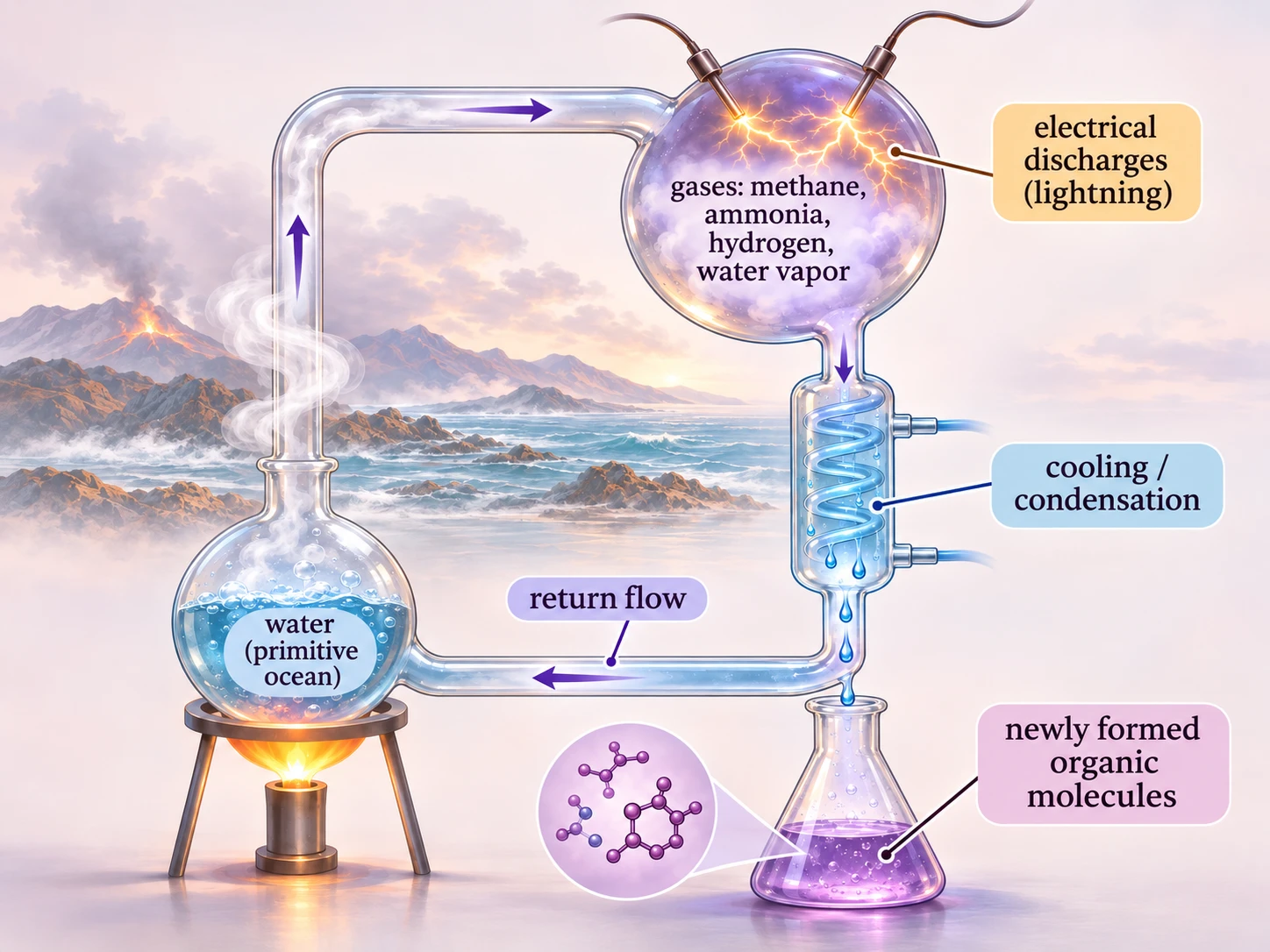
Miller designed a clever, closed-loop apparatus made of interconnected glass flasks. Rather than setting off a single, one-off chemical reaction, his setup mimicked a continuous planetary cycle.
In a smaller flask, Miller boiled water to simulate the ancient ocean evaporating from the planet's surface.
The rising steam traveled into a larger glass chamber filled with methane, ammonia, and hydrogen—standing in for the primordial atmosphere.
Inside this upper chamber, two electrodes fired continuous electric sparks to simulate flashes of lightning in a stormy sky.
Next, the zapped gases and steam passed through a cooling condenser. The water vapor condensed back into liquid droplets—artificial rain—and trickled down into a trap before cycling back into the boiling flask, carrying any newly formed, water-soluble compounds along with it.
The entire process came down to four continuous steps:
- Water heated up and evaporated.
- Water vapor and atmospheric gases were bombarded with electric sparks.
- The vapor cooled and condensed into liquid.
- The liquid cycled back into the “ocean,” starting the loop all over again.
The electric sparks provided the energy needed to break the chemical bonds of the simple starting gases, creating reactive fragments that could recombine into entirely new compounds.
In essence, Miller had built a simplified, self-contained Earth in a bottle. The system was completely sterile and contained no pre-made biological materials.
He switched it on and let it run for seven days.
After just one day, the water took on a pinkish hue. By the end of the week, the liquid had turned a cloudy, deep red. Something had clearly happened inside the glass—but a color change alone didn’t prove anything about the origins of life. Miller needed to know exactly what was floating in the broth.
The Breakthrough: Complex Organic Molecules
To appreciate what Miller found, it helps to clear up a common misconception about what the word “organic” means in chemistry.
In everyday language, we associate “organic” with living things. In chemistry, however, organic compounds are simply a broad class of carbon-based molecules—often bonded with hydrogen, oxygen, nitrogen, and other elements. (Not every carbon compound makes the cut; carbon dioxide, for instance, is considered inorganic.) Most importantly: “organic” does not mean a substance came from a living organism.
In fact, one of Miller’s starting ingredients—methane—Already qualified as a simple organic compound. The real test of the experiment wasn’t merely turning inorganic matter into organic matter; it was seeing whether simple, everyday gases could naturally assemble into the much more complex organic molecules required by living cells.
The answer was a resounding yes.
Miller analyzed the dark broth using paper chromatography, a technique that separates different chemicals in a mixture into distinct spots on a sheet of paper, allowing them to be identified by comparing them to known substances.
Sitting right there on the paper were amino acids.
In his original 1953 paper, Miller definitively identified three amino acids: glycine, alpha-alanine, and beta-alanine. He spotted faint traces of a few others as well, though he couldn’t yet confirm them with certainty.
Why did this send shockwaves through the scientific community?
What Are Amino Acids, and Why Do They Matter?
Amino acids are relatively small organic molecules, and a specific set of them serves as the building blocks of proteins—one of the most vital classes of molecules in the living world.
Proteins do the heavy lifting in almost every living cell. They provide structural support, transport materials, and act as enzymes—biological catalysts without which the chemical reactions of life would grind to a halt.
A protein is essentially a long chain of amino acids folded into a precise three-dimensional shape. Both the exact sequence of the amino acids and the way the chain folds determine what job that protein can do.
Think of amino acids as the letters of the alphabet. Using the same set of letters, you can write a grocery list, a legal contract, or a Shakespearean play. On their own, however, a handful of scattered letters do not make a story.
Similarly, a flask containing a few amino acids does not contain working proteins—and it certainly doesn’t contain life.
Miller hadn’t brewed cells, proteins, or living creatures. What he demonstrated was that the fundamental “letters” of biology could form spontaneously on a lifeless planet. That was the true breakthrough.
A Two-Page Paper That Launched a New Field
Miller’s paper was published in Science on May 15, 1953.
Only one name appeared at the top. Even though Harold Urey had inspired the project, guided the research, and provided the lab, he insisted on taking his own name off the paper. He knew that if a Nobel Prize winner’s name was listed alongside a grad student’s, Miller wouldn’t get the recognition he deserved.
The discovery captured the public imagination overnight.
Some popular press outlets got carried away, acting as if scientists were on the verge of conjuring living creatures in the lab. The reality was much more grounded, yet scientifically profound.
Before 1953, the origin of life was largely the realm of armchair speculation. Miller’s experiment turned it into an experimental science. Suddenly, researchers could test different gas mixtures, energy sources, and environmental conditions, then analyze the resulting chemical products.
In the years that followed, labs around the world repeated and tweaked the setup, swapping electric sparks for ultraviolet light, adding minerals, and altering the chemical recipes.
Today, this field is known as prebiotic chemistry—the study of the chemical processes that preceded and paved the way for biology. Miller wasn't the first chemist in history to synthesize an organic compound from non-living materials, but his experiment became a landmark because it directly linked prebiotic synthesis to a plausible model of the early Earth.
The Flaw That Complicated the Story
From the very beginning, however, a giant question mark hung over the Miller–Urey experiment: Was Earth’s early atmosphere really like the gas mixture inside Miller’s flask?
Miller and Urey relied on the assumption that the young Earth was shrouded in a strongly reducing atmosphere packed with methane, ammonia, and hydrogen.
Those conditions are ideal for cranking out amino acids. Yet as geology and planetary science advanced over the following decades, researchers found strong evidence to challenge that model.
Modern geochemical models suggest that Earth’s early atmosphere was shaped heavily by volcanic outgassing and was dominated by carbon dioxide, nitrogen, and water vapor. While it lacked the abundant free oxygen of today’s air, it probably wasn’t nearly as hydrogen-rich and reducing as the mixture in Miller’s classic apparatus.
We still don’t know the exact recipe of the ancient sky—direct geological evidence from over four billion years ago is scarce, and the atmosphere itself likely changed over time.
Still, this shift in thinking mattered. When scientists ran Miller-style experiments using mostly carbon dioxide and nitrogen, the reactions were far less productive, yielding barely a trickle of amino acids.
Did this mean Miller’s famous experiment was a dead end? Not quite.
First, the fundamental chemical principle remained intact: given the right conditions, simple precursors naturally assemble into biological building blocks. What changed was our understanding of where on Earth those conditions might have existed.
After all, a planet isn’t uniform. Even if the global atmosphere was dominated by carbon dioxide and nitrogen, local environments could have been dramatically different.
Erupting volcanoes, for instance, spew out local plumes of reducing gases, steam, and mineral ash—and volcanic plumes are notorious for generating intense lightning storms. In these localized hotspots, the chemistry may have looked remarkably similar to what was happening inside Miller’s glass bulbs.
Today, origin-of-life researchers are less focused on finding a single, planet-wide chemical recipe. Instead, they look at how diverse local environments could have acted as specialized chemical factories.
Decades Later, a Time Capsule Opens
The story of the Miller–Urey experiment didn’t end in 1953.
Throughout his career, Stanley Miller ran dozens of variations on his original setup, including experiments designed to mimic steam-rich volcanic eruptions. Crucially, he dried and saved the residues from many of these runs in small glass vials.
After Miller passed away in 2007, his former students discovered boxes of these preserved vials sitting in his lab—a scientific time capsule waiting to be opened.
By the late 2000s, analytical chemistry had leaped light-years ahead of 1950s paper chromatography. Using modern liquid chromatography and mass spectrometry, scientists could detect tiny traces of molecules that had been completely invisible in Miller’s youth.
In 2008, researchers re-analyzed vials from one of Miller’s volcanic-style experiments conducted in the 1950s. They discovered that the steam-injected volcanic setup had actually produced a wider variety of amino acids than his famous 1953 apparatus.
Then, in 2011, another team analyzed vials from an unpublished 1958 experiment. In that run, Miller had added hydrogen sulfide (
H2SH2S
)—a foul-smelling gas commonly belched out by volcanoes—to his gas mixture.
The modern instruments revealed an astonishing 23 different amino acids and four amines in the 50-year-old residue, including several sulfur-containing organic compounds that had never been seen in such experiments before.
This doesn't mean Miller’s original 1953 run made all those compounds—the 1958 experiment used a different chemical recipe, and modern detectors are vastly more sensitive. Nevertheless, the rediscovered vials proved that volcanic environments on the early Earth could have been far richer chemical kitchens than anyone realized in the 1950s.
Even the Glass Flask Played a Hidden Role
One of the most fascinating twists in the Miller–Urey saga arrived as recently as 2021.
A team of researchers asked a deceptively simple question: Was the glass apparatus in Miller’s experiment just a passive container holding the chemicals, or was the glass itself getting involved in the reaction?
To find out, the scientists ran the classic experiment in three different setups: one made of standard borosilicate lab glass, one made entirely of inert Teflon, and a third made of Teflon with small pieces of borosilicate glass dropped inside.
The results were striking.
The reactions run inside glass—or in the presence of glass shards—produced a much greater diversity and higher yield of organic compounds than the pure Teflon setup. The researchers concluded that reactive chemical groups on the silica surface of the glass, along with trace elements dissolving into the water, were actively catalyzing key steps in the chemistry.
Why does that matter?
On the primordial Earth, prebiotic reactions obviously didn’t take place inside sterile Pyrex flasks. But they didn’t take place in inert Teflon containers, either. Water and gases on the early Earth were in constant contact with silicate rocks, clay, and mineral surfaces.
Minerals are known to help concentrate organic molecules, shield them from breaking down, and catalyze chemical reactions. Unwittingly, Miller’s borosilicate glass flask had been doing double duty: it held the gases in while quietly standing in for the silicate rocks of the early Earth.
What was long assumed to be an inert piece of labware turned out to be an active participant in the chemistry.
How Science Views the Origin of Life Today
Since 1953, origin-of-life research has grown into a vast, interdisciplinary field. Today, we know that making amino acids is only the opening chapter of a much longer, multi-step story.
To build a living cell, having a soup of loose building blocks isn't enough. Living systems need a way to store and copy genetic information, a metabolic network to harness energy, and a membrane boundary to keep their internal chemistry separate from the outside world.
Modern researchers generally break this puzzle down into three interconnected questions:
1. Where did the raw building blocks come from?
Beyond Miller-style atmospheric chemistry, scientists now explore many pathways for making amino acids, sugars, lipids (fats), and the components of genetic material. And Earth didn’t have to make all of them from scratch. Carbon-rich meteorites—like the famous Murchison meteorite, as well as pristine asteroid samples recently returned from space—are packed with amino acids and other prebiotic molecules, suggesting that cosmic impacts helped seed the young planet with organic raw materials.
2. How did those building blocks link together?
Amino acids floating in a vast ocean won’t easily link up into proteins; in fact, excess water tends to break those chemical bonds apart. To form long chains (polymers), the molecules needed to be concentrated and coaxed into reacting. Today, scientists study environments like shallow ponds that go through repeated wet-dry cycles, mineral surfaces that act as chemical scaffolding, and alkaline hydrothermal vents on the ocean floor.
3. How did self-sustenance and heredity emerge?
This remains the toughest hurdle of all. For Darwinian evolution to take over, a chemical system has to be able to copy itself and pass information to its "offspring," complete with occasional variations.
One leading idea is the RNA World hypothesis, which proposes that early life relied on RNA-like molecules capable of doing two jobs at once: storing genetic information (like DNA) and catalyzing chemical reactions (like proteins). Other researchers focus on self-sustaining metabolic networks ("metabolism-first" models) or self-assembling lipid bubbles (protocells)—or argue that all three had to co-evolve together.
We still do not have a single, universally accepted blueprint that traces every step from simple gases to the first living cell. As scientific reviews through 2026 continue to emphasize, researchers have made remarkable strides in solving individual pieces of the puzzle, yet the complete, unbroken timeline remains elusive.
We now know dozens of ways nature can forge the ingredients of life. What we still cannot prove is exactly which combination of pathways, in what order, and in which ancient environment actually sparked biology on Earth.
The Enduring Legacy of the Miller–Urey Experiment
Looking back more than seventy years later, Stanley Miller’s achievement appears both more modest and more profound than it did in 1953.
It seems more modest because we now realize just how vast the chasm is between a few simple amino acids and a living, dividing cell—and because our picture of the early Earth’s atmosphere has evolved considerably since the 1950s.
Yet it is even more profound because it gave science a roadmap.
Miller didn’t just brew a handful of organic compounds. He showed how to take one of humanity’s oldest philosophical questions—Where did we come from?—and break it down into testable, manageable laboratory experiments.
What molecules can form from simple precursors? How do temperature, energy sources, water, and mineral surfaces steer those reactions? Hundreds of laboratories around the world are still chasing the answers to the questions Miller helped frame.
And as the 21st-century reanalysis of his old vials and the discovery of the glass flask’s catalytic role remind us, good science isn’t frozen in the moment it’s published. New tools and fresh perspectives can breathe new life into experiments conducted half a century ago.
The Miller–Urey experiment didn’t solve the mystery of how life began. What it proved, once and for all, is that the basic ingredients of life are not the exclusive property of living things—and that the chemistry of life is deeply woven into the natural laws of the universe.


